

China’s Desalination Breakthrough
China’s Desalination Breakthrough
Fresh Water is Cheaper Than Tap, Plus Green Hydrogen
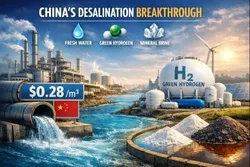
China has reportedly launched a pilot desalination project in Rizhao, Shandong province that claims to produce ultra-pure freshwater from seawater at an exceptionally low cost—about 2 yuan (roughly US$0.28) per cubic meter. If that figure holds beyond a pilot setting, it will undercut many global desalination benchmarks and may even be cheaper than tap water in parts of China.
The facility, described as operational since early December 2025, is designed to run on low-grade waste heat from nearby steel and petrochemical plants, meaning it with no added energy input and reduce the emissions intensity typically associated with thermal desalination.
It’s framed as a “one-in, three-out” system: seawater goes in, and the plant produces three useful outputs:
- Fresh water
- High-purity green hydrogen (reported at approximately 4.2 kWh per cubic meter of H₂)
- Mineral-rich brine intended for industrial reuse
The pilot is said to have demonstrated continuous operation for more than 500 hours, supporting the idea that it can function as a low-carbon, circular model for coastal industrial hubs.
This is still a pilot—processing hundreds of tons per year, not municipal-scale volumes. The real significance is the potential for a scalable template: combining direct seawater electrolysis concepts with waste-heat integration to bypass steps, reduce energy costs, and generate multiple monetizable outputs.
A Brief History of Desalination
Desalination's roots trace back millennia. Ancient texts, like Aristotle's Meteorologica around 350 BCE, described distillation: heating saltwater to evaporate and condense fresh water. Sailors in ancient India and Greece used similar methods by 2000 BCE, boiling seawater on ships. Fast-forward to the 19th century: land-based plants emerged in Latin America's arid coasts, using multi-effect evaporation (MED) for mining camps. The modern era kicked off in 1928 with the first commercial land-based plant in the Netherlands Antilles (now Curaçao), producing 60 cubic meters per day via distillation. Post-WWII, tech advanced: the U.S. built a demo plant in Freeport, Texas, in 1961 using multi-stage flash (MSF) distillation. Europe followed in 1964 with Spain's first plant. The 1970s breakthrough? Reverse osmosis (RO), invented by Sidney Loeb and Srinivasa Sourirajan in the 1960s, which uses membranes to filter salt under pressure—more energy-efficient than thermal methods. By the 1980s, RO dominated, dropping costs from over $5/m³ to under $1/m³ today. Now, over 20,000 plants worldwide produce ~100 million m³/day, mostly in the Middle East.
Global Desalination Plants: Costs and Comparisons
China's $0.28/m³ sets a new low for integrated systems, but how does it stack up? Global seawater desalination costs typically range from $0.50 to $2.50 per cubic meter, depending on plant size, energy source, and location. Large-scale RO plants average ~$0.70/m³ for outputs over 300,000 m³/day. Operational expenses dominate (energy ~50%), with nuclear or renewables helping keep them down.
Key players:
- Ras Al Khair, Saudi Arabia (world's largest, 1 million m³/day, hybrid MSF/RO): Costs ~$0.60–0.80/m³, powered by cheap natural gas.
- Taweelah, UAE (909,000 m³/day, RO): Around $0.50/m³, thanks to solar integration and economies of scale.
- Sorek B, Israel (600,000 m³/day, RO): One of the cheapest at ~$0.40/m³, supplying 20% of Israel's water with efficient membranes.
- Shuaiba 3, Saudi Arabia (600,000 m³/day, MSF): Similar to Ras Al Khair, $0.70–0.90/m³.
- Carlsbad, USA (190,000 m³/day, RO): Higher at ~$1.50–2.00/m³ due to U.S. energy prices and regulations.
Middle Eastern giants like Saudi Arabia (producing 18% of global desalinated water) and the UAE lead with low costs via subsidies and fossil fuels, but China's waste-heat model could disrupt that—especially if scaled, potentially hitting $0.20/m³ or less.
In the US Specifically
The largest operational plant is Carlsbad (California, 50M gallons/day), developed by Poseidon Water (private, focused on US coastal desal like Huntington Beach proposal). Poseidon is a subsidiary/portfolio company linked to infrastructure investors (e.g., Brookfield has ties historically, though ownership evolves). Other US projects (e.g., in Texas, Florida proposals) are often private (like Seven Seas Water, owned by EQT private equity after Morgan Stanley sale) or municipal.
No direct public stock for a US plant, but CWCO and ERII offer US-listed exposure that could benefit from domestic growth (California/Texas droughts pushing more proposals). Desalination is a long-term growth theme (market projected to double by 2030+), but stocks can be volatile due to regulatory hurdles, energy costs, and environmental concerns.
Top Publicly Traded Options (as of late 2025)
- Consolidated Water Co. Ltd. (NASDAQ: CWCO) → Closest to a "pure-play." Operates seawater reverse osmosis (SWRO) desalination plants primarily in the Caribbean (Cayman Islands, Bahamas, British Virgin Islands). Recently expanded into the US (Hawaii) and Mexico (potential large project near California border). Small-cap (~$575M market cap), pays dividends, and benefits directly from growing demand in water-scarce tourist/island regions.
- Energy Recovery Inc. (NASDAQ: ERII) → Specializes in energy recovery devices (like the PX Pressure Exchanger) that cut energy costs in RO desalination by up to 60%. Used in plants worldwide; desalination is their core business. Higher growth potential as efficiency becomes key in new projects.
- Veolia Environnement (OTC: VEOEY or Paris: VIE) → World's largest desalination operator (built ~2,000 plants). Major exposure via water division, including massive projects in the Middle East and Australia. Diversified (waste, energy too), but desalination is a big growth driver.
- American Water Works (NYSE: AWK) → Largest US regulated water utility; some involvement in desalination/tech, but mostly broader water supply. Stable dividends play with minor desal exposure.
Other mentions (less direct):
- ACWA Power (Saudi Tadawul: 2082) — Huge in Middle East desalination (e.g., world's largest plants); not US-listed, requires international broker.
- Acciona (Madrid: ANA) Builds/operates plants globally.
- Equipment/tech: Former GE Water (now part of Veolia/Suez merger).
The opinions voiced in this material are for general information only and are not intended to provide specific advice or recommendations for any individual.
All investing involves risk including loss of principal. No strategy assures success or protects against loss.